Personal Trainer YouTube Channel: How to Build a Lead-Generating Channel With Just 1 Video a Week
Most personal trainers either ignore YouTube or try it for 4 weeks and quit because they posted 4 videos that got 30 views each. The trainers who actually book clients from YouTube do one thing different: they treat it as a 12-month search engine play, not a 30-day social media play.
YouTube is the second-largest search engine in the world. People type "kettlebell workout for beginners," "how to fix my squat," and "personal trainer in [city]" into YouTube the same way they Google. A video that ranks for one of those terms keeps pulling in viewers, subscribers, and discovery calls for years. This guide is the full playbook to make that happen on one video per week.
Why YouTube Is the Highest-Compound Marketing Channel a Trainer Can Build
Three numbers explain why YouTube outperforms every other content platform over a 12-month horizon.
- Average video lifespan: Instagram post lasts 48 hours. TikTok lasts 5 to 7 days. YouTube video lasts 2 to 5 years and often longer. The same effort, very different returns over time.
- Search intent: 70 percent of YouTube views come from search or suggested videos, not from followers. Subscriber count matters far less than on Instagram. A 200-subscriber channel can still get thousands of views per video if the topic is searchable.
- Conversion to discovery call: YouTube viewers convert to email subscribers at 3 to 7 percent (vs. 0.5 to 1.5 percent on Instagram) because they spent 8 to 12 minutes watching you before they ever clicked. The trust is already built.
A trainer who posts one video per week for 12 months typically lands at 1,000 to 5,000 subscribers and 3 to 8 free booked discovery calls per month coming in from the channel on autopilot. The work front-loads. The results compound.
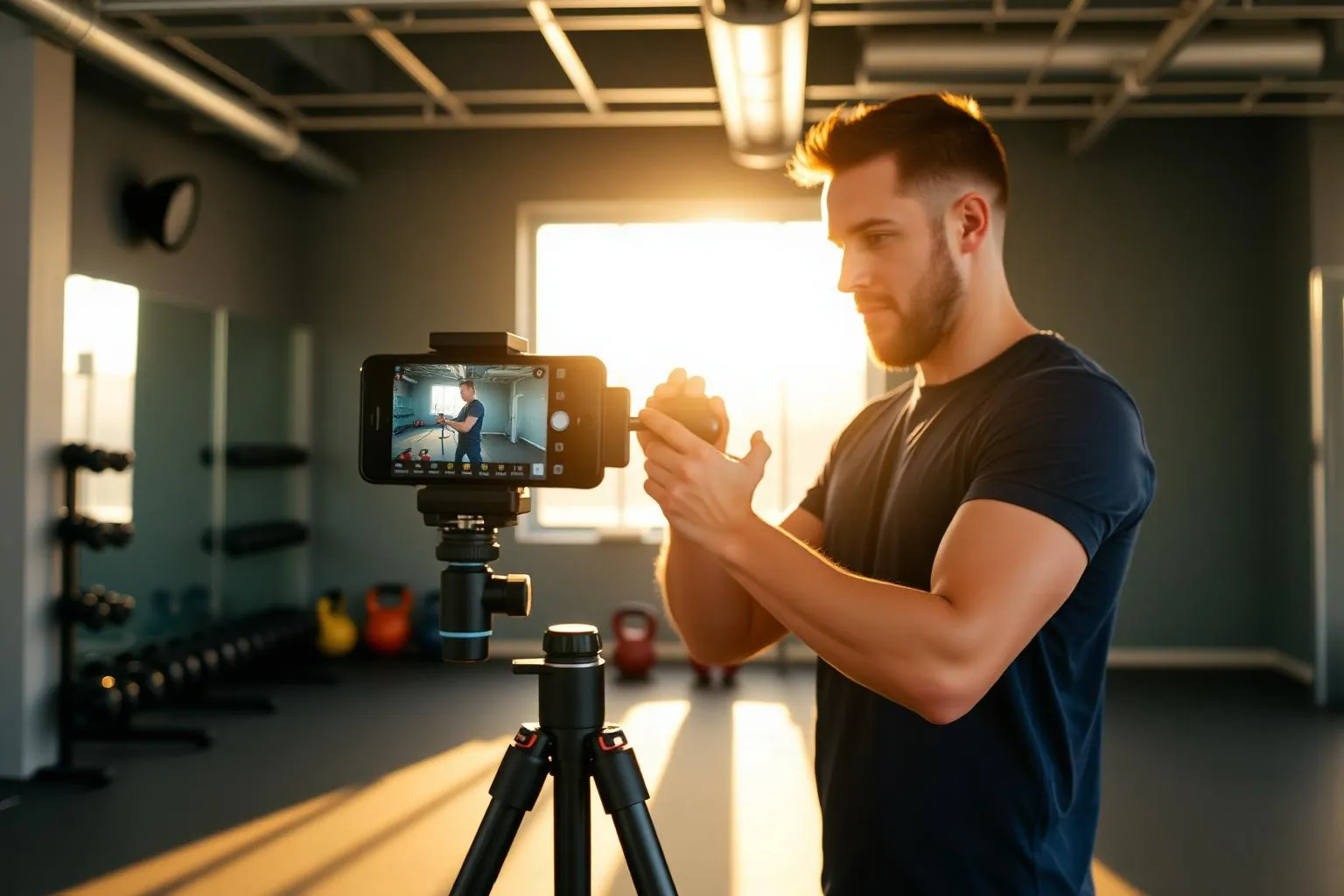
The Phone-and-Mic Setup (Total Cost: Under $100)
You do not need a real camera, a studio, or expensive lighting. The full setup most trainers use in 2026:
- Smartphone — Whatever you already own. iPhone 11 or newer / decent Android both shoot great 1080p video.
- Wireless lavalier microphone ($40 to $80) — A Hollyland Lark M1, Rode Wireless ME, or DJI Mic Mini. This is the single most important piece. Audio quality is the difference between someone watching for 8 minutes or clicking off in 30 seconds.
- Small phone tripod ($15 to $30) — Manfrotto Pixi, JOBY GorillaPod, or any flexible mini tripod for filming yourself.
- Natural light or a $30 ring light — Film near a window during the day for free. For evening filming, a small ring light works.
- Free editing app — CapCut on phone (totally free) or DaVinci Resolve on laptop (free). No need for Premiere Pro or Final Cut.
Total cost: $60 to $130 one-time. That is the entire production stack for a channel that can grow to 100,000 subscribers.
Channel Setup (Do This Once, Get It Right)
Six things must be set up before video #1 goes live.
- Channel name: Use your real name OR a clear niche brand. "Sarah Lee Strength" or "Coach Mike Fit" beats "Maximum Fitness Inc." Real names trust better.
- Channel handle: Match your Instagram handle if possible (@yourname). Consistency helps cross-platform follows.
- Channel banner: Simple banner with your name, your specialty in 4 to 6 words ("Strength training for women over 35"), and your upload day ("New videos every Sunday"). Canva has free templates.
- Channel description (the About tab): 100 to 150 words. Who you help, what you teach, where they can work with you. Include 2 to 3 keyword phrases naturally.
- Pinned link in description and "About" section: Direct link to your discovery call booking page or email opt-in. Every video description points here too.
- Channel trailer: A 45 to 75 second video pinned at the top of your channel that introduces you, your niche, and what new viewers will get if they subscribe. Record this AFTER you have 3 to 5 videos under your belt so it does not feel forced.
The 5 Video Types That Actually Book Clients
Trainers waste months filming the wrong videos. These 5 types do all the heavy lifting. The percentage is roughly how much of your content mix each one should be.
1. How-to tutorials (60 percent of content)
The single most searchable video type. Examples: "How to deadlift safely for beginners," "How to fix knee pain when squatting," "5 best dumbbell exercises for back fat," "How to lose belly fat after 40." These videos rank in YouTube search for years because the search volume is steady and most existing videos are mediocre.
Optimal length: 7 to 12 minutes. Optimal structure: hook (15 seconds), why this matters (45 seconds), the actual teaching (5 to 8 minutes with on-screen demos), recap (30 seconds), CTA (15 seconds).
2. Myth-busters (15 percent of content)
People click on contrarian takes. Examples: "Cardio does not actually burn fat (here is what does)," "The squat depth myth that ruins knees," "Why eating 6 small meals a day is wrong." These get the highest click-through rates and bring in viewers who would never search for a tutorial.
Optimal length: 6 to 10 minutes. Structure: state the myth, briefly explain why it became popular, prove why it is wrong with one clear point, give the right approach.
3. Client transformation walkthroughs (10 percent of content)
Pure social proof. Examples: "How my client Sarah lost 30 pounds in 16 weeks (without giving up wine)," "Mike went from 0 pull-ups to 10 in 12 weeks. Here is exactly what we did." These convert viewers to discovery calls at the highest rate.
Optimal length: 10 to 15 minutes. Structure: where the client started, what they had already tried, your method in 3 to 4 phases, the result with real numbers, what the client says about the experience.
4. Q&A / answering viewer questions (10 percent of content)
Once you have an audience, ask in your videos and on Instagram, "What is the #1 question you want me to answer?" Then make one video answering 5 to 7 of the best questions back to back. Examples: "I answered your top 7 questions about strength training over 50."
Optimal length: 12 to 18 minutes. Structure: list the questions in the first 30 seconds with timestamps, then answer each one in 1 to 2 minutes.
5. Day-in-the-life / behind-the-scenes (5 percent of content)
Personality content. Examples: "A day in the life of a personal trainer," "My morning routine," "What I eat in a day at 40." These do not get massive search traffic but they build deep trust with the subscribers who already follow you. Save these for once every 6 to 8 weeks.
The Title and Thumbnail System That Actually Gets Clicks
Titles and thumbnails do 90 percent of the work. A great video with a bad thumbnail gets 50 views. A mediocre video with a great thumbnail and title gets 50,000.
Titles
- Lead with the keyword: "Kettlebell workout for beginners (10 minutes, no experience)" not "I made you a kettlebell workout."
- Add a curiosity hook in parentheses: "(without going to the gym)," "(I was wrong)," "(works for anyone over 40)."
- Keep under 60 characters so it does not get cut off in search.
Thumbnails
- Your face, big, clear expression — Surprise, intense focus, or excitement work best. Neutral faces get ignored.
- 3 to 5 large words max — "5 SQUAT FIXES," "EAT THIS TO LOSE FAT," "MY BIGGEST MISTAKE." Readable on a phone screen.
- High contrast colors — Bright yellow text on dark background. Red circles drawing attention to a body part.
- Make 2 to 3 versions in Canva — YouTube lets you A/B test thumbnails. Use it on every video.
The Video Description and Tags System
The first 2 to 3 lines of your description show in search. Use them to deliver value AND insert your top call-to-action.
Description template (copy this, customize per video):
- Line 1: One-sentence summary of what the viewer will learn.
- Line 2: Direct link to your discovery call page or email opt-in.
- Line 3: Timestamps if it is a longer video (helps watch time AND ranking).
- Lines 4 to 8: 150-word expanded description with 3 to 5 keyword phrases naturally included.
- Bottom: Links to your other relevant videos, your Instagram, your podcast, etc.
For tags, use 8 to 12 tags per video. First tag should match your title keyword exactly. Then variations and related searches.
The Weekly Production Workflow (3 to 4 Hours, Once Per Week)
The schedule that lets a busy trainer publish weekly without burning out.
- Sunday afternoon (45 min): Pick this week's topic and outline. Use the 5 video types as a rotating menu. Keep a running list of 30 to 50 topic ideas in a Google Doc so you never start from blank.
- Monday morning (60 min): Film the video. One take if possible. Two takes max. Filming yourself the same time every week becomes a habit.
- Tuesday or Wednesday evening (60 to 90 min): Edit in CapCut. Trim, add basic on-screen text for key points, add a simple intro card. Skip fancy effects.
- Thursday (30 min): Make the thumbnail in Canva. Write the title, description, tags. Schedule for Sunday 9 AM upload.
- Sunday morning (auto-publish): Video goes live. Share the link in your Instagram story, your email newsletter, and your community.
Total weekly time: 3 to 4 hours. Pair this YouTube workflow with the 90-day social media content calendar for repurposing — every YouTube video should become 3 Instagram Reels, 5 carousel slides, and 1 email broadcast.
The First 90 Days: From Zero Subscribers to a Real Channel
- Week 1: Set up the channel (handle, banner, description, link). Brainstorm 30 topic ideas using the 5 video types.
- Weeks 2 to 4: Film and publish the first 3 videos. Do not film a channel trailer yet — let your first 3 videos define your style.
- Weeks 5 to 8: Publish weekly without missing a Sunday. Record your channel trailer in week 6 and pin it. Add timestamps to longer videos.
- Weeks 9 to 12: Start a "comment back" routine. Reply to every single comment in the first 24 hours after upload. Engagement signals to YouTube that the video is worth pushing.
By day 90, most trainers land between 50 and 250 subscribers. That feels small but the foundation is set. The growth between months 6 and 12 is usually 5 to 10x because YouTube starts trusting the channel as consistent and your back catalog starts ranking in search.
The 5 Mistakes That Kill YouTube Channels
- Inconsistent schedule. Posting 3 videos in week 1, then nothing for a month. YouTube's algorithm rewards predictable upload schedules. Same day, every week, for 52 weeks.
- Filming what YOU want, not what people search. "My favorite chest workout" gets 30 views. "Chest workout at home with dumbbells (no bench needed)" gets 30,000. Search intent wins.
- Bad audio. Echoey rooms, no mic, wind noise. Viewers click off in 15 seconds. A $40 mic fixes 90 percent of this.
- Quitting before month 6. Almost every channel that hits 10,000+ subscribers had under 200 subscribers at month 3. The compound starts late. The trainers who stop at month 4 never see it.
- No CTA in videos. Telling viewers to "subscribe" without ALSO directing them to your email opt-in or discovery call link wastes the trust you just built. Every video needs a clear single next step.
How to Convert YouTube Viewers Into Discovery Calls
The path looks like this: Viewer searches YouTube → watches your video → trusts you → clicks the link in description → lands on your opt-in page → enters the 7-email welcome sequence → books a discovery call by email 6 or 7.
The handoff from YouTube to email is the critical step. Never send YouTube viewers directly to a sales page. Send them to a free lead magnet (a 5-day program, a meal plan, a cheat sheet) that drops them into your email sequence. The sequence does the trust-deepening, story-telling, and asking. YouTube does the discovery.
Pairing YouTube With the Rest of Your Marketing
YouTube is the long-game discovery engine. Pair it with:
- A 7-email welcome sequence to convert viewers into booked calls.
- The 90-day social content calendar for repurposing every video into Reels, carousels, and emails.
- A local SEO setup so trainers serving a city also rank for "personal trainer [city]" inside YouTube.
- The discovery call script for the calls the channel books.
- Strong objection handling so the calls close.
The Bottom Line on Personal Trainer YouTube
YouTube is the only platform where 4 hours of work this Sunday can still be sending free clients in 2030. The setup is under $100, the workflow is one video per week, and the 5 video types are well-documented. The trainers who treat it as a 12-month search engine play (not a 30-day social media play) and post every single Sunday for a year almost always cross 1,000 to 5,000 subscribers and 3 to 8 free booked discovery calls per month. Most trainers will quit at month 4. That is exactly why the few who do not have an unfair advantage.
Related Reading
- 90-Day Social Media Content Calendar
- 7-Email Welcome Sequence
- Personal Trainer Local SEO Playbook
- Discovery Call Script That Closes 8 of 10 Prospects
- 7 Sales Objections and Word-for-Word Responses
- 5 Marketing Channels That Still Work for Trainers
For deeper research on YouTube algorithm signals and creator growth benchmarks, YouTube's Creator Academy and Buffer's YouTube marketing statistics are the most current industry references.