
Personal Trainer Semi-Private Training: How to 3x Your Hourly Rate Without Working More Hours
If you are stuck at $5,000 to $10,000 per month doing 1-on-1 sessions, the problem is not your effort. The problem is your business model. There is a hard ceiling on hourly trading. Semi-private training removes the ceiling by stacking 3 to 5 clients into the same physical hour without turning into a group class.
This guide gives you the full operating system: the model, the math, the station layout, the program design, the pricing, the schedule, and the exact script that converts existing 1-on-1 clients into semi-private spots without making them feel demoted.
Semi-Private Is Not Group Class (The Critical Distinction)
Most trainers confuse semi-private with bootcamp or group fitness. They are not the same business model.
- Group fitness = everyone does the same workout, no individualization, low price, low retention.
- Semi-private training = 3 to 5 clients in the same hour, each on their own program written for them, sharing the floor and the trainer's attention in a structured rotation.
The semi-private client still gets a custom program, custom progressions, custom accountability, and personal eyes on their form. They just share the hour and the floor. That single distinction is why retention in semi-private is usually HIGHER than 1-on-1, not lower.
The Math: Why Semi-Private Triples Your Hourly Rate
Here is the side-by-side a typical 1-on-1 trainer should run before doing anything else.
The 1-on-1 model (the ceiling)
- Rate: $100 per hour
- Sessions per week: 25 max (sustainable) = $2,500/week = $10,000/month
- Each new client adds the same fixed billable hour.
The semi-private model (the unlock)
- 4 clients per hour at $70 per session = $280 per training hour
- 20 training hours per week × $280 = $5,600/week = $22,400/month
- Working LESS (20 hours vs 25) and earning 2.2x more.
At 5 clients per hour and $80 per session, the same 20-hour week produces $32,000 per month. This is how trainers cross $20K to $30K per month without scaling a team. The model just changes.
The Ideal Semi-Private Setup (Equipment + Space)
You do not need a giant studio. You need a clean, defined zone with 4 to 5 stations.
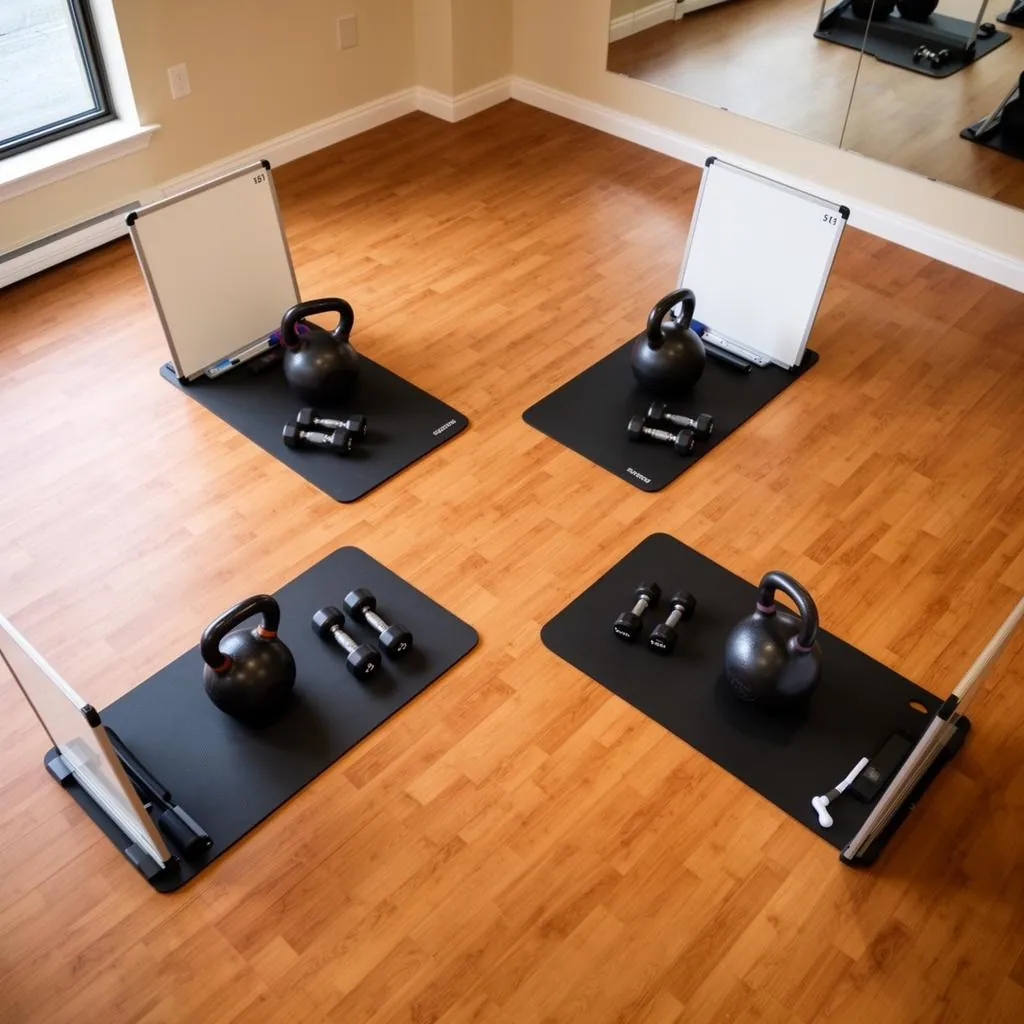
Minimum viable setup.
- Floor space: ~400 to 600 sq ft is plenty for 4 to 5 clients.
- Equipment: 2 squat racks or one rack + a Smith machine, dumbbells 5 to 80 lb in 5 lb jumps, 2 to 4 kettlebells, 2 benches, 2 cable stations or bands, mats, foam rollers.
- Station markers: Floor cones, taped-off zones, or small whiteboards labeling each station 1 through 5.
- Display: A wall-mounted TV or large whiteboard showing the day's circuit and timing.
You can run a successful semi-private model in a corner of a commercial gym, a 600 sq ft basement studio, or a half-bay garage. The structure matters far more than the square footage.
The Program Design (The Hardest Part Most Trainers Miss)
This is where most trainers fail semi-private. They try to write 4 fully separate programs and end up running around frantically. The trick is a shared TEMPLATE with individualized prescriptions.
The shared structure
Every client on the floor today is doing the same template: 10-minute warm-up flow, A1/A2 strength superset, B1/B2 strength superset, C1/C2/C3 metabolic finisher. The order, timing, and rest are identical.
The individualized layer
Inside that template, each client has their own exercises and loads. Client 1 is squatting 185 lbs because they're rehabbing a knee. Client 2 is deadlifting 285 lbs. Client 3 is doing a goblet squat because they're pregnant. Client 4 is doing a Bulgarian split squat because they're a runner with a glute imbalance.
Each client has their program on their phone via an app like GoCoach or written on their personal whiteboard. They see their movements, sets, reps, and loads. You see the same template in your head and rotate through the floor with cues, spots, and form corrections.
For program structure ideas that translate cleanly into a semi-private template, see the program design for client results guide.
The Rotation Rhythm (How One Hour Actually Runs)
The 60-minute breakdown of a typical semi-private session with 4 clients.
- 0:00 to 0:10 (Warm-up): All 4 clients run the same dynamic warm-up flow on their stations. You walk the floor checking quality.
- 0:10 to 0:25 (Strength Block A): Clients rotate through 2 paired exercises. You spend ~3 minutes per client giving cues, spotting, adjusting loads. Cycle through all 4 twice.
- 0:25 to 0:40 (Strength Block B): Same rotation, different superset.
- 0:40 to 0:55 (Metabolic Finisher): 3-exercise circuit at each station. Less coaching needed. You log notes for next session and answer last questions.
- 0:55 to 1:00 (Cool-down + check-in): Everyone stretches. You log session notes in the app, schedule next sessions, and send everyone off.
After 4 weeks of running this rhythm it becomes second nature. The first 6 sessions feel chaotic. Stick with it.
Pricing the Semi-Private Model (3 Proven Structures)
Three pricing structures that work in 2026. Pick the one that matches your market.
Structure 1: Per-Session Pack (lowest commitment)
12 sessions for $840 (= $70/session). Use this only for trial conversions. Cap at 1 pack per client. Move them to recurring after.
Structure 2: Monthly Recurring 2x/week (the sweet spot)
$560 per month for 2 sessions per week at $70 each. This is where 70 to 80% of clients should sit. Stripe subscription, auto-bill, 30-day cancellation notice.
Structure 3: Monthly Recurring 3x/week (high-value)
$780 per month for 3 sessions per week at $65 each. Slightly lower per-session price as the loyalty/volume discount. Best clients sit here and stay for 18+ months.
Compare those numbers to 1-on-1 (typically $100 to $150 per session). Semi-private clients pay 30 to 50 percent less per session and you earn 2 to 3x per training hour. For the broader pricing psychology that makes 3-tier offers work, see the pricing psychology playbook.
The Scheduling System (Why 4 Hours a Day Beats 8)
The dirty secret of 1-on-1 trainers is that they spread 6 hours of work across a 12-hour day with dead time between sessions. Semi-private fixes the schedule too.
The ideal semi-private week.
- Monday/Wednesday/Friday — 5 AM, 6 AM, 7 AM, 9 AM (4 morning slots, 4 clients each = 16 clients per day at $70 = $1,120 per morning).
- Tuesday/Thursday — 5 AM, 6 AM, 9 AM, 4 PM, 5 PM, 6 PM (mix of morning and after-work, 6 slots per day).
- Saturday — 7 AM, 8 AM, 9 AM (3 slots = $840 in 3 hours).
- Sunday off.
Total: ~22 training hours per week, $15,000 to $20,000 monthly revenue depending on rate. Compare that to dragging across 50 hours of dead-time 1-on-1.
The Conversion Script (How to Move 1-on-1 Clients to Semi-Private)
Current 1-on-1 clients are the first place to fill semi-private slots. Most trainers fumble this conversation. Use this exact script.
Hey [name], I wanted to share something I'm rolling out and you came to mind first because of how serious you've been about your training. Starting next month I'm opening up a small-group format — 3 to 4 clients per session, each on your own custom program (same one I'd write for you 1-on-1), but in the same hour. The energy is unreal, the price drops from $[X] per session to $[Y] per session, and the people I'm inviting are exactly the kind of training partners that push you. Want me to save you a spot in the Monday/Wednesday 6 AM block? It's 4 spots total and I'd like one to be yours.
Notes on this script. The phrase "you came to mind first because" makes them feel chosen, not demoted. The "same program I'd write for you 1-on-1" eliminates the fear of being downgraded. The price drop is real and they value it. The scarcity ("4 spots total") drives a fast yes. Expect 60 to 80% of qualified 1-on-1 clients to take the offer.
The Community Effect (Why Retention Is Higher)

Trainers expect semi-private retention to be worse than 1-on-1. It is almost always BETTER. Reasons:
- Accountability: Missing a session means letting the group down, not just the trainer.
- Energy: Other people in the room makes the work feel easier and the hour faster.
- Community: Real friendships form. People keep training because they like the people.
- Lower price: Easier to justify in the household budget. Less likely to cancel during tough months.
- Better progress: Friendly competition drives effort. Clients hit numbers in semi-private they would never push for alone.
Most well-run semi-private clients stay 18 to 36 months versus 8 to 14 months for 1-on-1. The retention math compounds the income advantage.
The 7 Mistakes That Kill Semi-Private Programs
- Trying to write 4 fully separate programs. Use a shared template with individualized loads and exercises.
- Letting strangers attend the first time without intake. Every semi-private client needs a 1-on-1 intake session first.
- Mixing fitness levels too aggressively. Beginner with advanced is OK if templates are flexible. Avoid pairing rehab with athletes.
- Skipping the app or whiteboard. Clients lose track without a visible plan. Use GoCoach or a printed program.
- Charging too little because "it is a group." Semi-private is premium service, not bootcamp. Price accordingly.
- Letting clients drop in randomly. Recurring weekly time slots are non-negotiable for community to form.
- Not capping at 5. Six or more breaks the model. Quality drops, retention drops, energy drops.
The Transition Plan (Move From 100% 1-on-1 to 80% Semi-Private in 90 Days)
The 12-week shift that converts a 1-on-1 book of business into a semi-private engine.
- Weeks 1 to 2: Design your template, build the program library, equip the floor, and pick 2 weekly time slots.
- Weeks 3 to 4: Run the conversion script with your top 8 1-on-1 clients. Aim to fill the first 2 semi-private blocks (8 spots).
- Weeks 5 to 8: Run the first semi-private blocks. Iterate the template every week based on what worked.
- Weeks 9 to 12: Open 2 more time slots, launch a "bring a friend" promo to existing semi-private clients (free trial session for the friend), and start marketing semi-private as the headline offer.
By month 4, 60 to 80% of revenue should be coming from semi-private with the remaining 20 to 40% from high-value 1-on-1 ($150 to $250 per session, capped at 8 to 10 clients).
The Bottom Line for Semi-Private Personal Training
The 1-on-1 model has a hard income ceiling and most trainers hit it inside 18 months. Semi-private removes the ceiling without removing the personal touch. 3 to 5 clients, 1 trainer, 1 hour, 3x the hourly rate, 30 to 50% lower per-client price, and better retention. The trainers earning $25K to $50K per month while working 4 hours a day are almost all running this model. The barrier is not skill or market — it is the willingness to change the structure of how you sell time.
Related Reading
- How to Build a $10K/Month Personal Training Business
- Scaling a Personal Training Business
- Personal Trainer Pricing Psychology
- Group Coaching for Fitness Business
- Personal Training Program Design
- Best Personal Training App for Semi-Private
For deeper background on small-group training models, the ACE Fitness and NSCA business resource libraries have free case studies on semi-private profitability worth reading.